
My Vipassana experience (August, 2024)
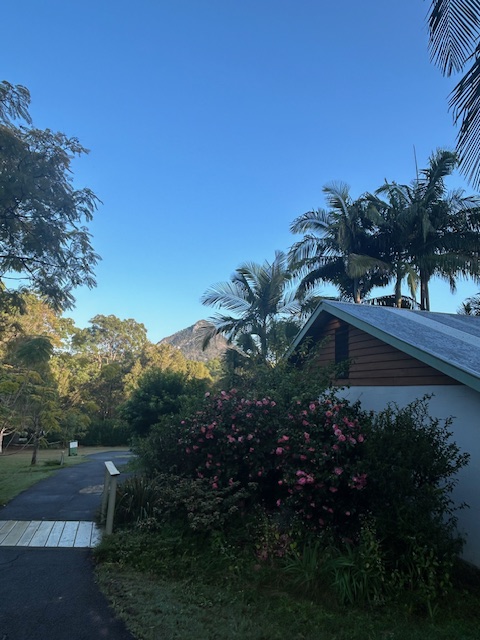
Along an unassuming bush track just off the main road to Pomona, Queensland is Dhamma Rasmi, the Queensland Vipassana Meditation Centre. Dhamma Rasmi means ‘ray of light or sunshine’ and has been hosting meditation students for decades under the commanding gaze of Mount Coorora.
In August 2024, I joined around 70 students from all walks of life on a 10-day silent retreat to learn the ancient Vipassana technique. These are my reflections.

Vipassana is a Pali word that means ‘to see things as they really are’ and is one of India’s most ancient techniques of meditation. The 10-day Vipassana meditation course was popularised by Burmese businessman S.N. Goenka in the 1970s, who learnt the technique from his teacher, Sayagyi U Ba Khin. It’s a simple and notoriously difficult technique which has flourished outside of Burma with around 200 Vipassana meditation centres around the world.
Through mindfulness meditation and focused concentration on body sensations, we’re taught to become more aware of our mental conditionings or saṅkhāra and to sense how these manifest as pleasant, unpleasant, or neutral sensations in the body.
During the course, students must observe ‘noble silence’ from 8pm on the first night for the next 9 days including no eye contact, no communication with other students or the outside world, no exercise, no reading or writing and no phones.
The rigorous schedule includes 10 hours of daily meditation, commencing 4.30am in the main hall, breakfast and 6.30am, meditation from 8am-11am, a lunch break until 1.30pm, meditation until 5pm, supper, more meditation from 6pm to 8pm, then discourse until approximately 9.30pm. We wake to the sound of gongs, which also signals movement between private rooms, the dining hall, the meditation hall and the gardens.
After handing over our keys, phones and material possessions to the Centre’s volunteers, each of us were allocated a small, simple room. A modest single bed, a pillow. Our only contact would be with a delegated support person and the ‘assistant teacher’, by appointment.


Lesson 1: My thoughts are an irritating soundtrack
We assembled in the main hall to meditate each day. The assistant teachers sat serenely on a stage, with a grounding, calm presence. Lessons were delivered through audio tracks and videos presented by the snuffy, nasally Goenka, including his chanting in Pali that I immediately found irritating and distracting.
During the first three days, before starting with the practice of Vipassana in earnest, we have to develop samatha, that is, a calm, sharp, and concentrated mind. To do to this we practiced āpāna sati, awareness of the natural breath and the sensations on the entire triangular area around the nose. We spent three days, or 30 hours meditating on the feel of the breath, and sensations around the area of the nostrils.
In those first days, despite thinking of myself as a practiced meditator, I could not calm my thoughts. The narrow focus of the meditation felt tedious. I distracted myself imagining far flung places, what I craved to eat, a dress I would wear, what I would write, who I love and don’t love, the pain of regret, grief and loss. I also made up child-like stories – I conjured up the eye of Horus, an encounter with a red snake, a white puppy in the palace, flying past moons of Jupiter, a phoenix rising, and on and on it went.
For the first few days I continued to be irritated by Goenka’s nasal narration and chanting. I felt restless and out of sorts. I tried to create some routine to ground the days, such as stretching after breakfast, a long walk around the gardens at lunch and sitting in the sun watching the kangaroos in the afternoon.
It also took some time to adjust to the meal plan, which was simple, delicious vegetarian breakfast and lunch, with just fruit on offer in the evening. The thought of having no dinner triggered a kind of scarcity mindset, which made me overeat in the morning after which I’d sit overstuffed and irritated during meditation.
Eventually, after three days, the incessant mind-chatter, restlessness and hunger started to die down. Slowly, slowly the mind quietened down becoming more of a soundtrack or background music. I came back to the breath, back to sensation and more equanimous awareness, observing a tingling around my nostrils. I observed my own repetitive thoughts, recurring memories, ideas, stories and emotions and begin to get a sense of where they connected in the body – for example, fearful thoughts seemed to cause chest tightness and pain in my lower back, regretful thoughts came with intense restlessness and an urge to run.
I began to sleep soundly at night and dream vividly.
Lesson 2: Getting to know the pain-body
On the evening of the third day, we were finally instructed shift our attention from the area around the nostrils to the crown of the head. I clearly recall a very tactile and intense creeping across my skin with a sense of expansion as the energy moved upwards. From there, we came into the Vipassana practice repeatedly scanning the body from head to toe, covering every inch to experience verdana or non-attachment to whatever sensation arose. I felt tingles, warmth, dullness, aches or nothing at all as I scanned my body.
On the fourth day, I began to feel very uncomfortable in my cross-legged position, developing sharp pains and aches in my back, hips and arms. At times, the pain was so intense I could not remain still and it took every bit of will and discipline not to scream and run from the hall.
Your body knows what the mind ignores. If you want to heal, stop overthinking and start feeling.
In Eckhart Tolle’s bestselling book ‘A New Earth’ he introduced the concept of the pain-body to describe an “energy field of old but still very-much-alive emotion that lives in almost every human being.” Tolle sees the pain-body as an obstacle that we must all face as we try to become more present in the moment.
This idea correlated strongly in Vipassana as I came to know my own body more deeply. My physical pains and emotional responses evolved sharply and viscerally. For a few days, each scan of the body elicited a different sensation or a pain response. Old memories surfaced, waxing and waning between joy and sadness, yearnings, loss, long held grief. My sankharas, like a snake uncoiling and rising up, with beady eyes reckoning.
This made sense to me from a somatic perspective, in that past trauma and stress can manifest in the nervous system, lying dormant until environmental or emotional triggers bring it to the surface, often without warning.
There was an energy shift in the hall as other students quietly grappled with their pain-body. By day 5 I relented and asked the teachers if I could have a seat to support my aching back, and in between sessions I sat in the sun and let silent tears fall.
“All sankhara are impermanent. When one perceives this with true insight, then one becomes detached from suffering; this is the path of purification.” S. Goenka
Lesson 3: Even transcendence is impermanent
By day 6 the pain began to subside, and I found that for the most part I could sit quite comfortably with my back supported on a low, cushioned chair. As the course progressed, the instruction progressed to scanning the whole body inch-by-inch from crown-to-toe and then working back upwards from toe-to-crown. Later, we let our attention flow more freely and simply followed the direction of energy as it moved around the body, with a feeling of the whole body being activated.
For three 1-hour sessions per day, we sat completely still in deep focused meditation. Despite any pain, itch or restlessness, we were instructed to stay still. By now the days had taken on a dream like quality. I was aware I was thinking, aware I was present, but had somehow detached from it. My body also felt very activated with waves of sensations moving through. I began to understand the subtle body on deep level as if it were a quiver of light, a vibration or expansion.
A few times I became so aware of the subtleness of sensations, reaching a state that could be best described as connection to source. I had no sense of here-and-now, no us-or-them, just a play in the pure rapture of a divine energic field. I begin to lift out of the physical body and explore an expanse that is impossible to describe. It were as if I’d activated a new level of sense perception to access a reality beyond our gross senses – sight, hearing, touch, taste, smell.
Moving more deeply into the practice of body scanning , I was also able to delve deeply inside the body, to slice it and move through it, feeling into organs and heartbeat, developing powerful interoception, and an ability to quickly activate any area of the body I focused my attention on.
However, despite these transcendent highs, next time I sat I might be back to dealing with my sankhara – dullness and heaviness of the body, pain, restlessness, negative thoughts.
After enlightenment, chop wood, carry water
I came to understand Vipassana as a shedding, with each sitting peeling a layer of deeply held memory which connected viscerally to some part of the body and spirit. But even if you reached nirvana’s peak, you’d have to be prepared to start again at base camp next time.
Lesson 4: The power and shape of language
Days 9 and 10 of the course were described as ‘reintegration’, with an end to the noble silence on day 9 followed by a community gathering, and the nurturing practice of ‘metta’ or compassion meditation.
By lunchtime on day 9 we were able to speak to each other again, the sounds of human voices a jarring reconnection to reality. I came to know the women who I’d walked with, shared meals with and sat with in complete silence. We talked and got to know each other in a way that can only take place through our silent bond, and I felt strongly how our language shapes our reality and sense of place. It was a warm, compassionate and nurturing re-entry to the world.
The 10 days, or 240 hours spent in silence at the Queensland Vipassana Centre was a cathartic experience that provided deep insight into the nature of our minds, and the incredibly complexity of reality.
Vipassana was a stern teacher and I’ll carry it’s lessons forward.
 RAYNEE DEWAR